
Precision Chemistry Data: Why You Must Convert One Ounce To Ml Exactly April « 2011 « Jim's Blog
To measure the volume of liquid in this graduated cylinder, you must mentally subdivide the distance between the 21 and 22 ml marks into tenths of a milliliter, and then make a reading (estimate) at the bottom of the meniscus In science, both accuracy and precision are crucial for obtaining reliable data and drawing valid. Refer to the illustration in figure 1.
Solved: A child drops a ball. The ball hits the ground and bounces. The
The big idea delve into precision and uncertainty in chemistry by learning how measurement tools—and their limitations—impact the reliability of your results, and how to communicate values using estimates of uncertainty for more accurate scientific reporting What are they, and why do we use them Three traits of a measurement we learned in lesson 1 that chemistry is a lab science.
- Viral Gospel Concert Clips From Baptist Church Glen Burnie Md Tours
- Social Media Erupts Over St Paul Tuition Fees Is Elite Education Worth The Cost
- Community Heritage Projects Secure The Future Of Oak Road Lutheran Church
Figure 1.26 to measure the volume of liquid in this graduated cylinder, you must mentally subdivide the distance between the 21 and 22 ml marks into tenths of a milliliter, and then make a reading (estimate) at the bottom of the meniscus.
The precision of a measurement describes the reproducibility of the value If you took this measurement again, how similar will the two measurements be One way to think about precision is as the spread or deviation of the measurements around their central (average) value. For example, if a volume is measured with an uncertainty of ±0.1 ml, the uncertainty must be considered when converting to liters
This is especially important in analytical chemistry, where quantitative results are often reported with confidence intervals. We assume you are converting between ounce [us, liquid] and milliliter You can view more details on each measurement unit Oz or ml the si derived unit for volume is the cubic meter
1 cubic meter is equal to 33814.022558919 oz, or 1000000 ml
Note that rounding errors may occur, so always check the results. The numbers of defined quantities are also exact By definition, 1 foot is exactly 12 inches, 1 inch is exactly 2.54 centimeters, and 1 gram is exactly 0.001 kilogram Quantities derived from measurements other than counting, however, are uncertain to varying extents due to practical limitations of the measurement process used.
Learning outcomes define accuracy and precision differentiate between measured and exact numbers determine the number of significant figures in a number and perform the calculation to the correct number of significant figures Perform calculations using conversion factors to change from one unit to another (e.g Use density to convert between mass and volume) However, samples smaller than 1 g need to be measured on an analytical balance to get the same precision

More significant figures mean higher precision, but do we always need to be very precise
Sometimes we need a very precise and accurate value, while other times close enough is good enough You need to consider why you are preparing the sample. Small errors can add up quickly if you're not getting precise measurements, and sometimes all you need is the most accurate values Learn how to make the right decision and choose the right instrument.
Study with quizlet and memorize flashcards containing terms like if your 10 ml graduated cylinder has markings for every 0.1 ml, how many decimal places should be recorded on your data sheet when this cylinder is used to measure volume?, why is a buret over filled and then drained to below the 0.00 mark?, you are using a pipet marked td Explain how you should drain the pipet to dispense the. Study with quizlet and memorize flashcards containing terms like accuracy, precision, accuracy is how close the measurement is to the correct (accepted) value Precision is how close a set of measurements are to each other (consistency) and more.
We would like to show you a description here but the site won't allow us.
Science is based on observation and experiment—that is, on measurements Accuracy is how close a measurement is to the correct value for that measurement The precision of a measurement system … Accuracy and precision are critical for achieving reliable and reproducible results
Read on to discover what these terms mean and how to improve your accuracy and precision. You can analyze this matrix to calculate different performance metrics These metrics include accuracy, precision, recall, and f1 score Each metric gives you different information about the model's strengths and weaknesses.
All measuring devices are subject to error, making it impossible to obtain exact measurements
Students will record all the digits of the measurement using the markings that we know exactly and one … An oceanographer needs to go out in a boat to collect an important temperature and salinity data logger that is attached to an underwater buoy How does each of the following situations illustrate the differences between precision and accuracy The oceanographer checks the weather forecast the night before her trip so she knows what to wear on the boat
The tv forecaster says it will be. This is where precision comes in Precision is how reproducible your results are, or how close a set of measurements are to each other If you measure the volume of a liquid multiple times with the same piece of glassware, do you get the same value each time
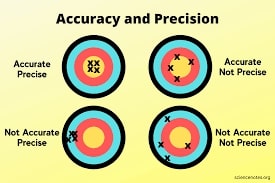
If you do, you know you're being precise, even if you can't determine your accuracy.
In this article, i'll break down everything you need to know about accuracy and precision and share my top tips for answering practical exam questions understanding precision and accuracy in science