The Laboratory Strategy For Using 1 Ounce To Millimeters In Precise Dosing High Permance Aumatic Dosg Barrel Chemical Dosg
Lab technician's guide to accuracy, precision, and reliability the world of laboratory science revolves around measurements, guided by essential concepts like standards, calibration, and traceability. Should you see cc used, 1 cc is the equivalent of 1 ml. Best practices and guidance are provided for standardizing dosing instructions on prescription container labels of oral liquid medications by eliminating use of u.s
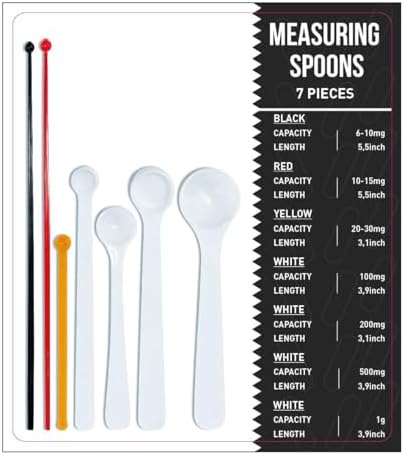
Dosing Spoon | Milligram Measuring Spoons Set of 7 | Exact dosing from
Customary (household) units and adopting metric units universally, with the goal of. Though the fda recommends using milliliter (ml) as the standard measurement for liquid medications, it is important to note that you may still see cubic centimeter (cc) used in practice This is particularly problematic with narrow therapeutic index drugs, where small differences in dosing can negatively impact therapeutic outcomes
- The Unseen Strategy Behind Kampes Bold Netflix Series Debut
- New Data Reveals Saint Pauls School Alumni Dominate 2026 Tech Unicorn Leadership
- The Great Debate Parents React To Saint Paul Schools 2026 Homework Policy Shift
In most cases, this difference in measurement is not clinically significant
However, for premature infants and neonates, precise calculations and uniform measurements must be used While slight differences in metric conversions do exist, the use of standardized metric equivalents aid greatly in accurate medication dosing and safe patient care. Dosage measurements some drug dosing errors stem from inaccurate measurements and administering improper amounts of chemical compounds to the patient Drug dosing normally utilizes the metric system, the apothecary system, or the household system.
If you are struggling with precision, it is usually a sign that you are using the instrument incorrectly or there is a problem with the equipment itself. Add 1.00 ml of the 10.0 m h3po4 to a little less than 1.00 l of water Add enough concentrated naoh to bring the ph to 8.00 (use calibrated ph meter) and then bring the volume to 1.00 l with water. Accuracy (closeness to true value) and precision (consistency of measurements) are vital in scientific experiments

To improve these in the lab, regularly calibrate and maintain equipment, use tools within their appropriate ranges, record significant figures correctly, and take multiple measurements
Be aware of shifts over time and the impact of human variability Systems of measurement safe medication administration is based on the safe calculation of drug dosages In this chapter, you will be introduced to foundational knowledge for working with both the metric system and the household system in the calculation of drug dosages Understanding and working with the systems of measurement commonly used in health care is an essential component of nursing.
In this lab, you will be introduced to some common measuring devices and learn how to use them to obtain correct measurements, each with correct precision A metric ruler will be used to measure length in centimeters (cm). We would like to show you a description here but the site won't allow us. Laboratory measurements and procedures introduction measurements of masses, volumes, and preparation of chemical solutions of known composition are essential laboratory skills

The goal of this exercise is to gain familiarity with these laboratory procedures
You will use these skills repeatedly throughout the semester. The ambiguity can be resolved with the use of exponential notation 1.3 × 10 3 (two significant figures), 1.30 × 10 3 (three significant figures, if the tens place was measured), or 1.300 × 10 3 (four significant figures, if the ones place was also measured). Precision represents how close different sample measurements you take are to one another, and accuracy represents how close those sample measurements are to the true measurement
Mint manufactures pennies to a standard of 2.5 grams If you weigh a penny five times, the closeness of each of your five measurements to one another is how precise your measurements are, but the. Accuracy in reporting experimental results two important issues are 1) how close is the experimentally reported average to the true value and 2) how reproducible or closely grouped was the data used in determining the average

The first issue deals with the concept of accuracy while the second deals with precision
To illustrate these two concepts, consider an experiment in which the density. A solution to use in a titration will probably require high accuracy, as you are using it to determine an unknown If you're making a solution you're going to standardize later, you might just need to know the approximate concentration of the solution, since you'll be determining the precise value later. Objectives to use standard laboratory measurement devices to measure length, volume and mass amounts
To use these measurements to determine the areas of shapes and volumes to determine the density of water To determine the density of a solid and use this to determine further quantities. Precise measurements are highly reproducible, even if the measurements are not near the correct value Darts thrown at a dartboard are helpful in illustrating accuracy and precision

The distribution of darts on a dartboard shows the difference between accuracy and precision
Working in a biotechnology lab requires knowledge of the metric system The metric system uses standardized units of measurement for length, mass, and volume, ensuring measurements are reproducible and easily made. As most medication syringes are in ml, it's also a good idea to be familiar with the ml in teaspoons, tablespoons, and ounces 1 teaspoon = 5 ml 1 tablespoon = 15 ml 1 ounce = 30 ml 3
These containers accomodate larger volumes of liquid but the droppers are often functionally equivalent in terms of dosage These containers are used to package herbal tinctures, essential oils, and include any number of menstrum to do so. These factors can be assessed to determine if a drug should or should not be a precision dosing candidate Figure 1 outlines key drug, disease state, patient population, and clinical implementation considerations that can be used to guide the assessment of precision dosing candidates.
To use a metric ruler to measure the dimensions of regular geometric shapes, and to use these measurements to determine the areas of the shapes
To measure the volume of a sample of water using a graduated cylinder and a beaker in order to compare their precision. Table 11.6 displays metric measurements and their equivalents